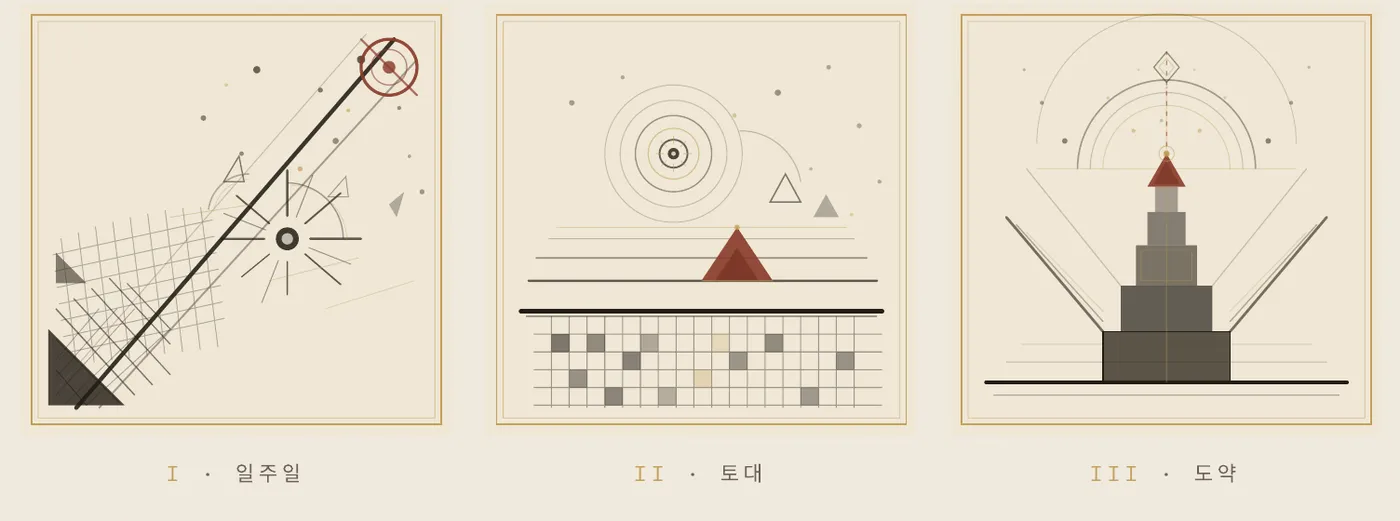
It started with one report, outside my field. This was two years ago, when I was in the planning department. I was told to produce a review report on a field I had never touched — within a week, and to a standard that would satisfy top management. I didn’t know where to begin. So for the first time, I opened ChatGPT and Gemini, which were just starting to spread.
It wasn’t easy. There were hallucinations, and sometimes it repeated the same sentence. It wasn’t at a level I could trust and use as is. But something struck me. Point the same tool in exactly the right direction, and it worked astonishingly fast. In the end, the question wasn’t “Does AI work?” but “How far do I trust it?” I settled one thing from the very start. Let AI do the extracting, but anything that can’t afford to be wrong, a person verifies all the way through. That rule became the backbone of how I have worked with AI ever since.
The first test was theory. When I tracked down the original, it turned out to be a 200-page book in English. Summaries were floating around, but wrong information could not go into a decision by top management, so the whole thing had to be verified.
- ChatGPT · Gemini
- Reviewing the English original’s core ideas and details · one-week deadline, 200 pages
- Cross-industry cases
- Checking whether the same phenomenon occurred · AI first pass + manual verification
- Team cross-check
- Filtering out hallucinations and repetition errors · everyone working late
In the old days I would have run it through translation, read all 200 pages, and summarized it all over again. That would have taken days. This time, AI pinned down the core ideas and even the details in a single pass. I didn’t let the time I saved sit idle; I spent it taking a second look at the passages that could not be wrong. Anyone who has written reports knows this: when the theory underneath is solid, the report is less likely to wobble. It has ground it can stand on.
AI could pull things in fast, but it was people who chose what to throw away.
Theory alone wasn’t enough. Next came other industries. I looked into whether the same thing had happened outside our industry. The hypothesis was simple: if something happened first in another industry, similar pressure would come to ours. AI gathered those cases quickly too, and the report gained one more piece of evidence to explain “why we need to look at this now.”
The verification was done by hand. We didn’t leave the cases and figures AI had pulled in as they were. We combed through Google and Naver, Korea’s biggest search portal, tracked down brokerage reports, research institute papers, and original news articles ourselves, and checked them one by one. Any sentence whose source we couldn’t pin down, we threw out. That’s why the whole team worked late.
The report wasn’t released with any fanfare. It was printed on paper and handed over in person, discreetly, for vice presidents and above only. And so one report, from a department that wasn’t even in charge, quietly made the rounds at the top.
That week was the beginning. What I learned then was less how to write a report than the verification loop: assign, doubt, assign again, and in the end a person takes responsibility. When I met Claude Code the following year, that loop was the first thing I thought of. At first it was a tool helping out with a single report, but once I kept giving it instructions, checking its work, and having it fix things, I started to think it could take over part of what a small team used to do. Looking back, I was less someone who was good at using AI than someone who drew the lines. I left it to AI to work through the 200 pages, and it was people, all week, who threw out the sentences whose sources couldn’t be pinned down. That is how _y Tower began. In the next issue, I’ll write about what I built and what I erased, one piece at a time.